PySTL
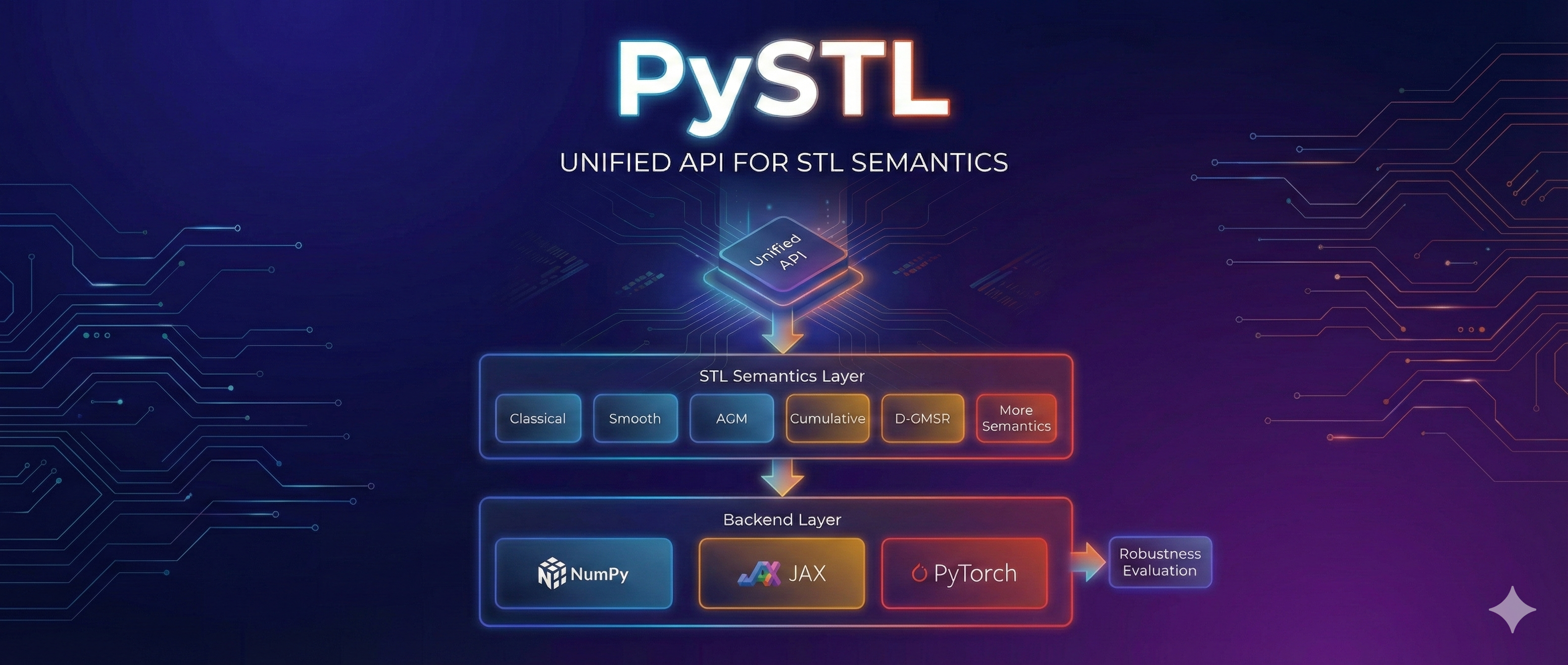
A unified API for Signal Temporal Logic (STL) robustness evaluation across multiple semantics and computational backends.
PySTL consolidates five STL quantitative semantics — Classical, Smooth, Cumulative, AGM, and D-GMSR — under one consistent interface. Switch semantics or backends without rewriting your formulas.
from pystl import Predicate, Interval, create_semantics

phi = Predicate("x_positive", fn=lambda s, t: s[t, 0]).always(Interval(0, 4))

rho_classical = phi.evaluate(signal, create_semantics("classical", backend="numpy"))
rho_smooth    = phi.evaluate(signal, create_semantics("smooth",    backend="jax"))
rho_agm       = phi.evaluate(signal, create_semantics("agm",       backend="torch"))
Contents
Supported Semantics
| Semantic | Smooth | Sign-preserving | Key idea |
|---|---|---|---|
classical |
No | Yes | min/max worst-case robustness |
smooth |
Yes | Approx. | Softmin/softmax via logsumexp |
cumulative |
Piecewise | No | Integrates robustness over time |
agm |
Piecewise | Yes | Arithmetic-Geometric Mean blending |
dgmsr |
Mostly yes | Yes | Generalized means, smooth + sign-safe |
Each semantic is available on three backends: numpy, jax, and torch.